"On" "a" "Need" "for" "a" "New" "Search" "Engine"

"On" "a" "Need" "for" "a" "New" "Search" "Engine"
Thursday, December 22, 2011

Once upon a midnight time
There was once a time when searching the Internet was a chore. There was Excite, Yahoo, Hotbot, WebCrawler, Go, Lycos, AltaVista, Dogpile, Ask Jeeves and God only knows a few others. Each engine had some strong points (I was a big fan of HotBot) but each also had serious weaknesses. These included:
-
•Limited page data. Most of these only had 5%-10% of the web indexed.
-
•Too few results. See point 1.
-
•Too many results. The results were of very low relevance and seemed random.
-
•Slow.
-
•Frequently clumsy.
-
•Busy layout.
And then came a savior to the Web. A small startup created by Sergey Brin and Larry Page. These two came up with a better mouse trap offering a new technology that algorithmically matched your search with the pages of high relevance. By looking at how web sites are actually linked and cross linked, these two came up with a web search that was light years ahead of the competition. Some defining characteristics were:
-
•Huge database. Simply HUGE beyond belief.
-
•Always used an “implied AND” search to allow limiting the results.
-
•Results were uncanny in their relevance.
-
•Fast. Like spooky fast.
-
•Simple design.
-
•Uncluttered.
-
•Special features for math, conversion and specified site searches.
The entire world had found a new search engine. Within months, Google took over the world by indexing the repsoitory of all web sights and providing a method to search through that data better than any company ever. Google Search really was that amazing.
All things fade in time
As time went on Google added new and fun capabilities to their list of products offered for free to the public. Google Maps, Google Earth, Google Translate and the list goes on. But things started to change slowly as well. Most of the changes were positive but slowly the changes drifted (IMO) from the original concept that made Google Search simply amazing.
At the onset, all searches were simply “implied AND” searches. If you typed in:

Google would do a simple search that looked like the following:
“Steven” AND “Noyes” AND “lightning” AND “photography”
and return the results. Some small changes were made to make life easier. What if “Steven” was actually a “Stephen” or “photography” was really “photographs” or “photograph”. To aid in these type of common common words and Google started doing searches like:
(“Steven” OR “Stephen”) AND
“Noyes” AND
“lightning” AND
(“photography” OR “photographs” OR “photograph)
But at the heart of life, Google was still an “implied AND” search but was helping on simply typos and words that meant the same but might have slightly different spellings. Life was good.
Then comes a bubble
We all live in a search “bubble”. Eli Pariser did an amazing TED talk about the internet Bubble. Are all bubbles bad? I don’t think so. If I want to get the address of the local mom and pop pasta hangout:
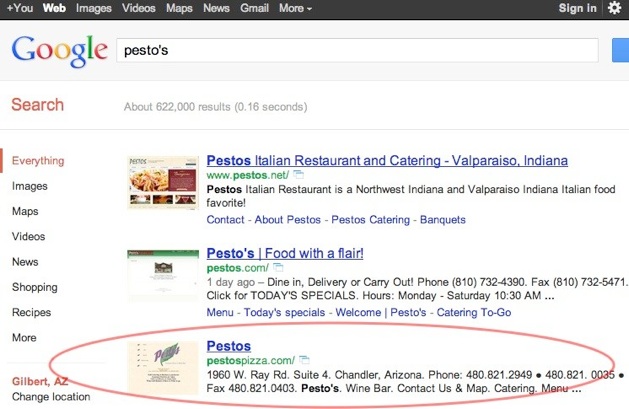
Not bad. By putting me in a geolocation bubble, Google got what I was looking for in the top 3.
Then comes an implied “OR”
At some point in the last 6-12 months, Google seems to have shifted to an “implied OR” search. Now, it seems, adding search terms can actually INCREASE the number of results coming from Google. For an example, lets say I search for “SDK”. This is short for Software Development Kit.

116 million hits. That is allot of hits but I want to filter this down so I will specify the iPhone SDK:
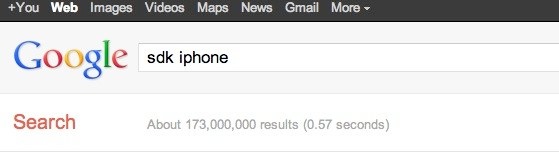
WHAT!!!! How did I get MORE answers? 173 million???? What is going on. But that is OK because Google allows using the “+” operator to force the AND of a term.
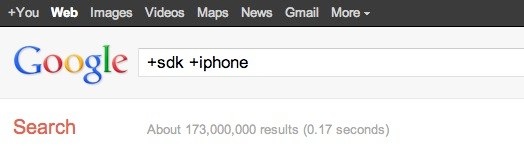
Sigh... Still not what I want. I still have 173 million results. So lets try forcing the literal search...
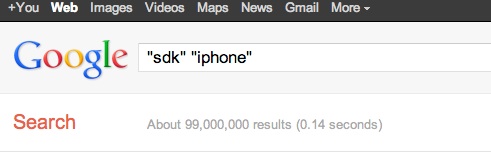
Ahhhhhh!!!! “Finally” “I” “know” “how” “I” “have” “to” “search” “for” “things”. “What” “a” “pain” “in” “the” “ass” “to” have” “to” “put” “quotes” “around” “every” “word” “but” “I” “am” “getting” “good” “at” “it”.
The “+” operator was removed from search to allow it to be used on Google’s new Google+ social network. Bummer they did not call it something like Google& or Google% or even Google$.
Clutter
That is a whole nother conversation. Google’s clutter is getting fierce. Ugly. Annoying. Promotes actually clicking the wrong thing. This is a discussion all on its own.
Then comes DuckDuckGo
So now I have found DuckDuckGo.com. This is a great little search engine that reminds me of the Google of old: small, light, great API, implied AND, clean, relevant results and no bubble. If I do my “Pesto’s” search I get a hundred recipes for making pesto. If I want to place a bubble on myself by adding Chandler locations:

DAMN!!! Even better than Google’s bubble applied search.
Have I found a new search engine? I think so. If I have to learn a new search engine because Google wants to take on FaceBook and destroy their search engine doing it??? Might as well try something new.
There comes a time when you wake up and realize the search engine you have slept with for the past 9 years is no longer the same search engine and you want a divorce.